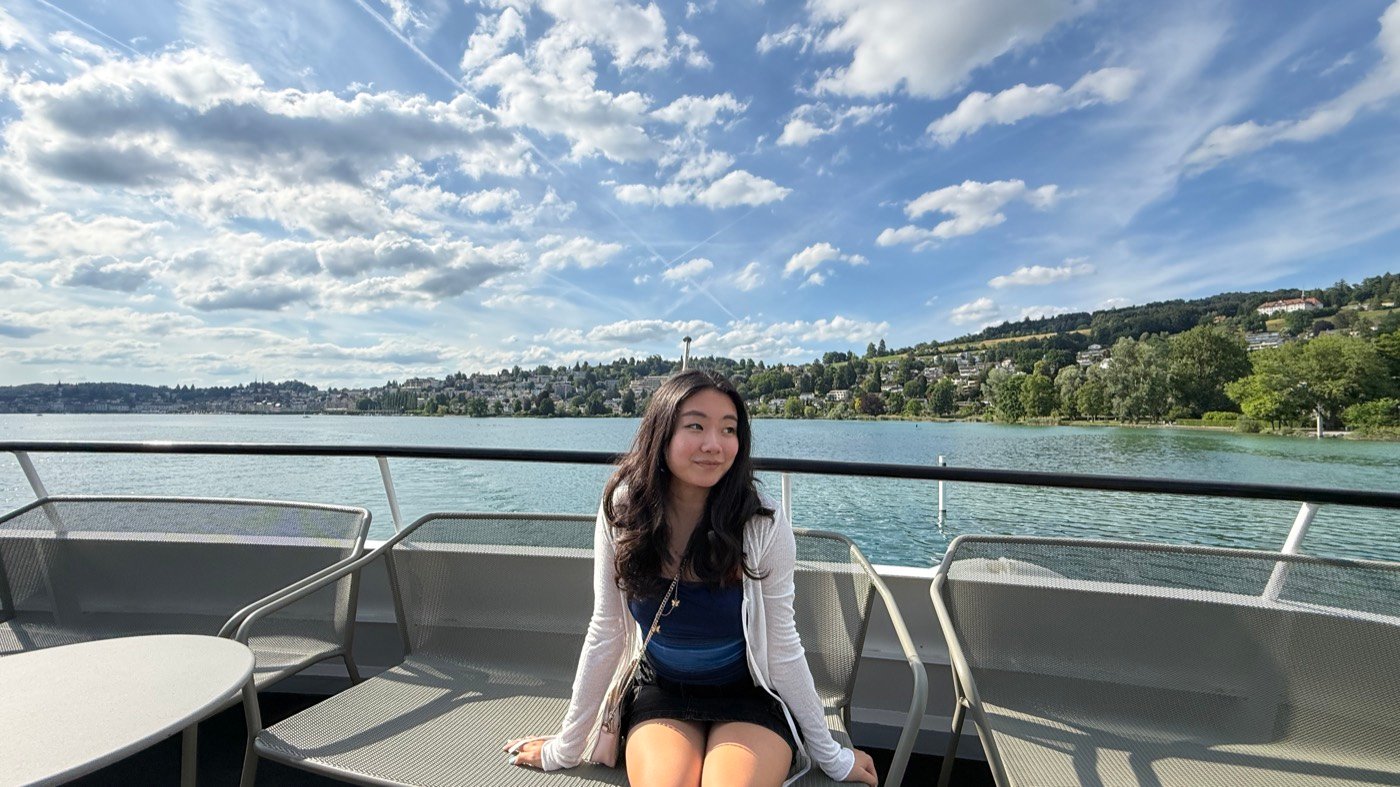
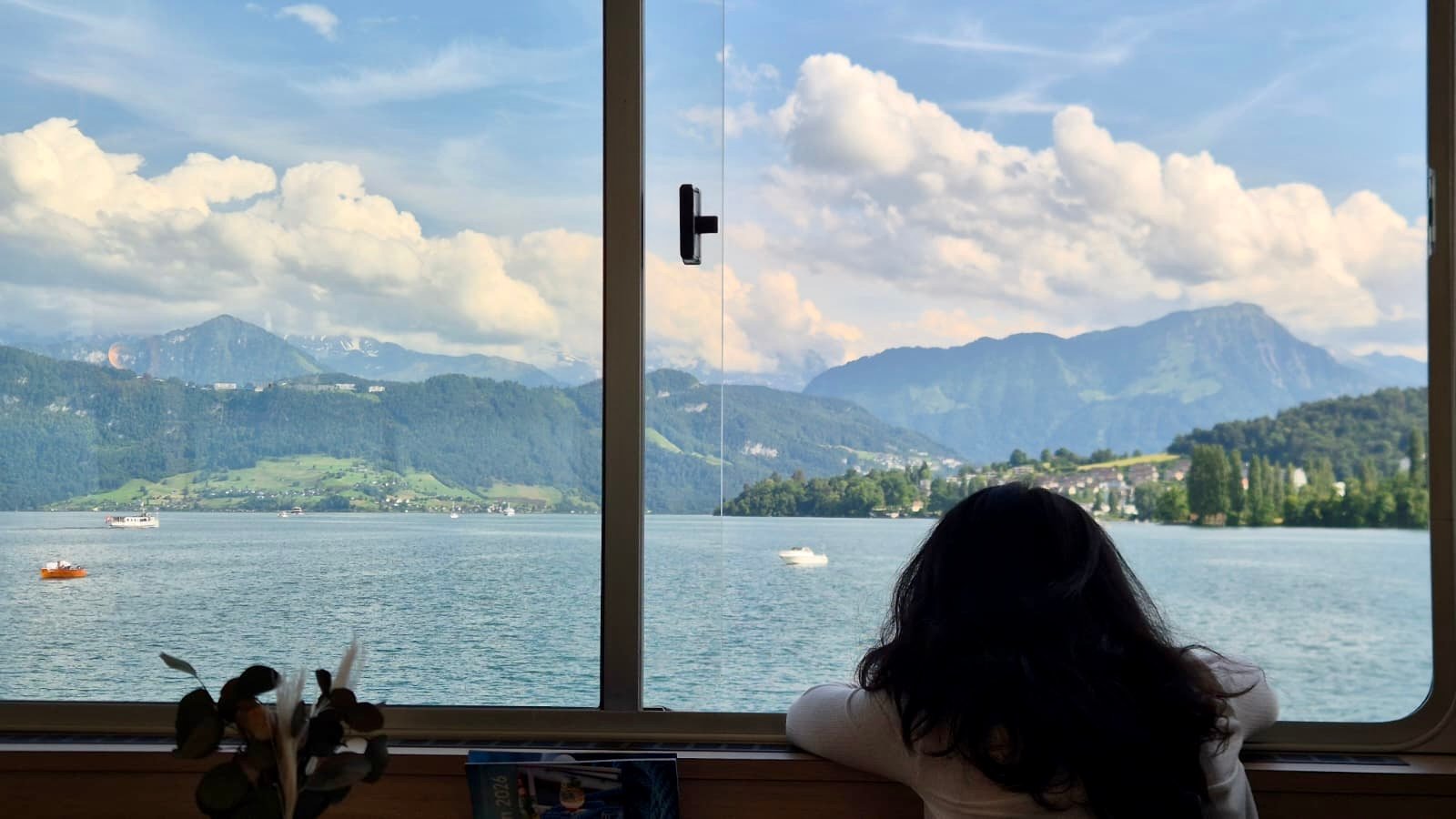
Everyone kept telling me Switzerland would empty my bank account, so I went with three friends, split a house, cooked most of our own food, and came home having done eight days for around CHF 1,000 each, flights aside. Not backpacker-cheap, because Switzerland never will be, but a long way off the horror stories. This is the honest version of how we did Switzerland on a budget: the full day-by-day itinerary based out of Luzern, every cost written down, and the one thing that did more than anything else to keep the total down, the Swiss Travel Pass.
If you only take one line from this post: sort your transport and your food before you go, and the rest of Switzerland is a lot more affordable than its reputation. Here is exactly how it worked for us.
I traveled on this trip in partnership with the Swiss Travel Pass, so I want to give you the real, unvarnished verdict.
How much does 8 days in Switzerland cost on a budget?
Here is what a week and a bit in Switzerland actually cost me, per person, sharing accommodation four ways. Everything is in Swiss francs (CHF), which sat close to parity with the US dollar while we were there in late spring.
| What | Cost per person (CHF) |
|---|---|
| Swiss Travel Pass (8-day consecutive, 2nd class, youth rate) | 311 |
| Airbnb (7 nights, whole house split 4 ways) | 420.50 |
| Groceries (cooked most nights) | 70 |
| One meal out (Erwins Imbiss-Stube, Luzern) | 25 |
| Mountain activities (on top of the pass) | ~165 |
| eSIM (Europe plan covering Switzerland) | ~12 |
| Odds and ends (laundry, snacks; tap water was free) | ~30 |
| Total, 8 days, flights excluded | ~1,033 |
That comes out to roughly CHF 130 a day, all in. The single biggest line is accommodation, and the second is the pass, which is also the thing that unlocked almost everything else we did. One number worth flagging if you are young: the 8-day Swiss Travel Pass is CHF 439 at the standard adult rate, but only CHF 311 if you are 25 or under, which is the rate we paid, so a big chunk of budget travelers can knock well over a hundred francs straight off that top line.
The biggest thing that kept accommodation down was splitting a whole house four ways. On your own, that same place would be your single biggest expense by far, so if you're travelling alone, look at hostels or a small studio outside the old town instead.
The 8-day Switzerland itinerary, day by day
We based every day out of Kriens and let the trains do the work. Here's exactly how the week ran, with the routes we took, each one fully or partially covered by the Swiss Travel Pass. Want more detail on any of them? They line up with the day trips in my Ultimate Swiss Travel Pass Guide.
Day 1: Arrive and settle into Luzern
Best for: an easy start and your first grocery shop.
Landed, trained into Luzern and dropped our bags in Kriens, then did the all-important first grocery shop before anything else. In the evening we walked Luzern's old town: the Chapel Bridge (Kapellbrücke) with its painted panels, the water tower beside it, and the lakefront. An easy start on purpose, because jet lag is not the day to attempt a mountain.
Day 2: Mount Rigi
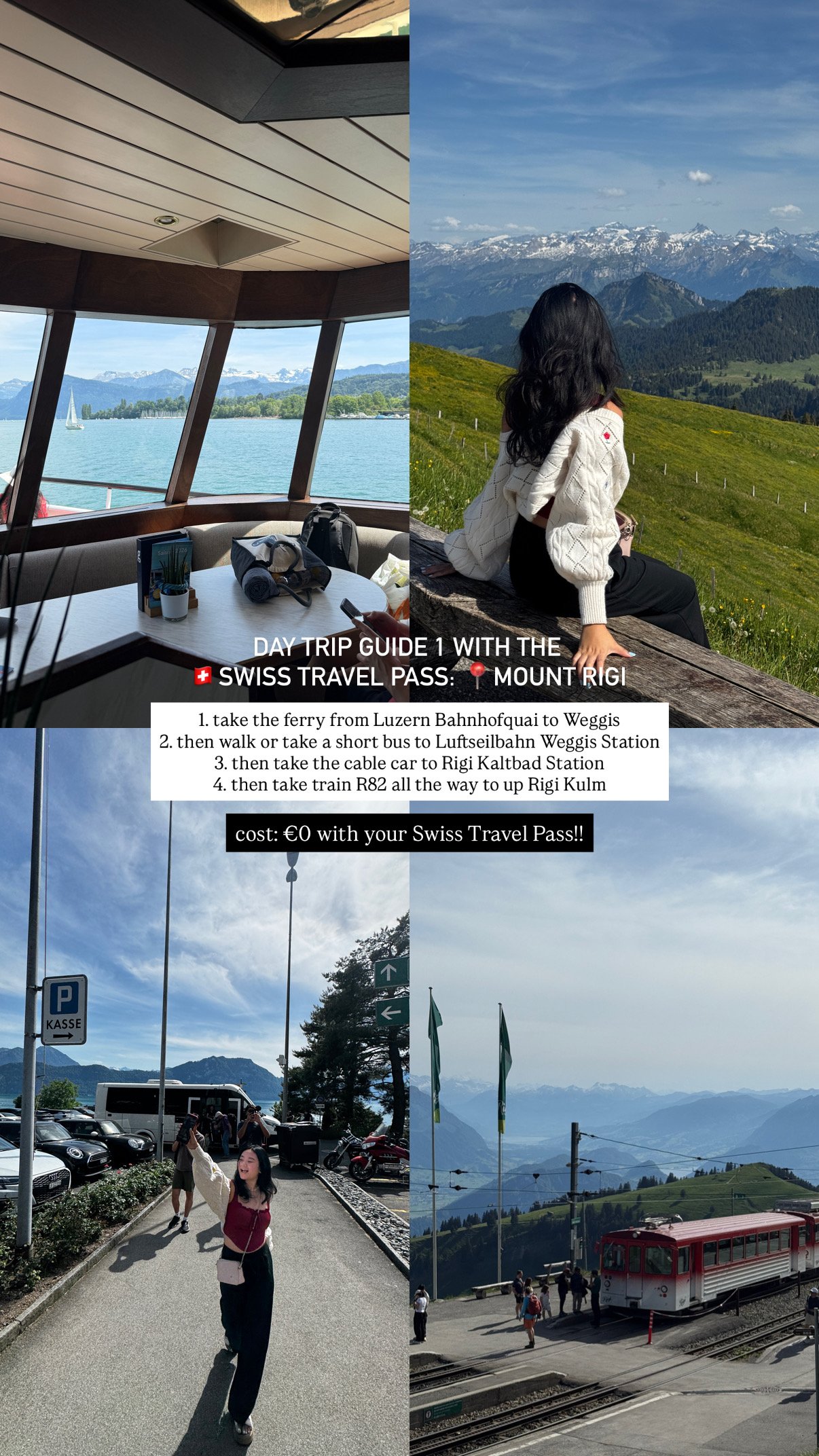
Best for: panoramic alpine views and first-time visitors.
- Take ferry 3600 from Luzern Bahnhofquai to Weggis.
- Walk or take a short bus to Luftseilbahn Weggis station.
- Take the cable car up to Rigi Kaltbad station.
- Board train R82 all the way up to Rigi Kulm (the summit).
If you do one thing from this list, do Rigi. Rigi Kulm sits at 1,797 m with a sweeping 360° panorama across the Alps and multiple lakes, and it's peaceful and uncrowded compared to Titlis or Pilatus. We came down a different way just because the pass let us, and were back in time to cook dinner.
Day 3: Interlaken & Lauterbrunnen
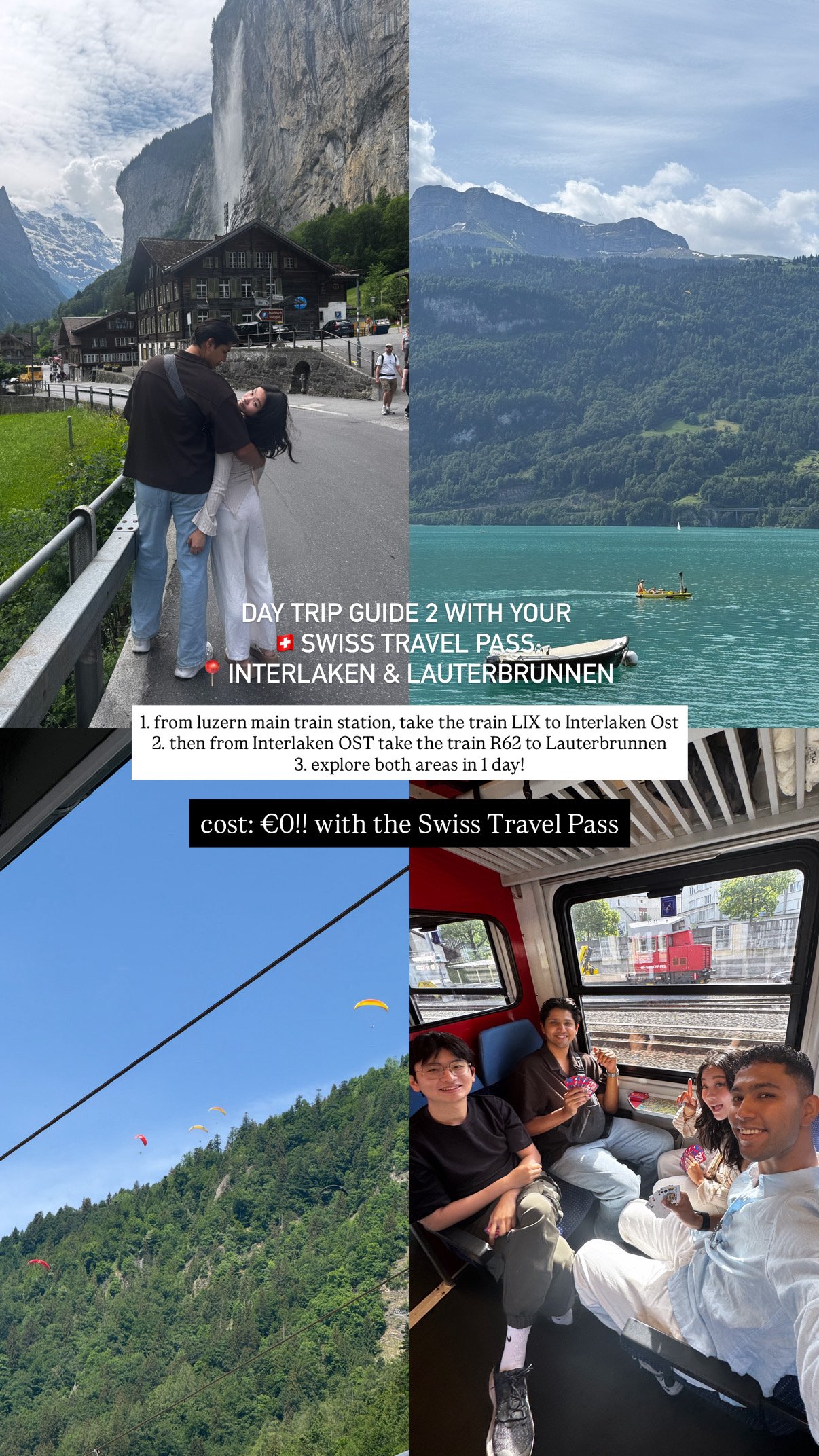
Best for: dramatic waterfalls, classic Swiss scenery, paragliders overhead.
- From Luzern main station, take train LIX to Interlaken Ost.
- From Interlaken Ost, take train R62 to Lauterbrunnen.
- Do both in one day, Lauterbrunnen in the morning, Interlaken in the afternoon.
Lauterbrunnen is one of those places you'll recognise from a thousand travel photos, a deep valley flanked by sheer cliffs with the Staubbach Falls plunging 300 m straight down. We walked the valley floor, which is free and honestly the best angle anyway, then carried on to Interlaken, sitting between its two impossibly blue lakes, for a slow afternoon by the water.
Day 4: Grindelwald & First
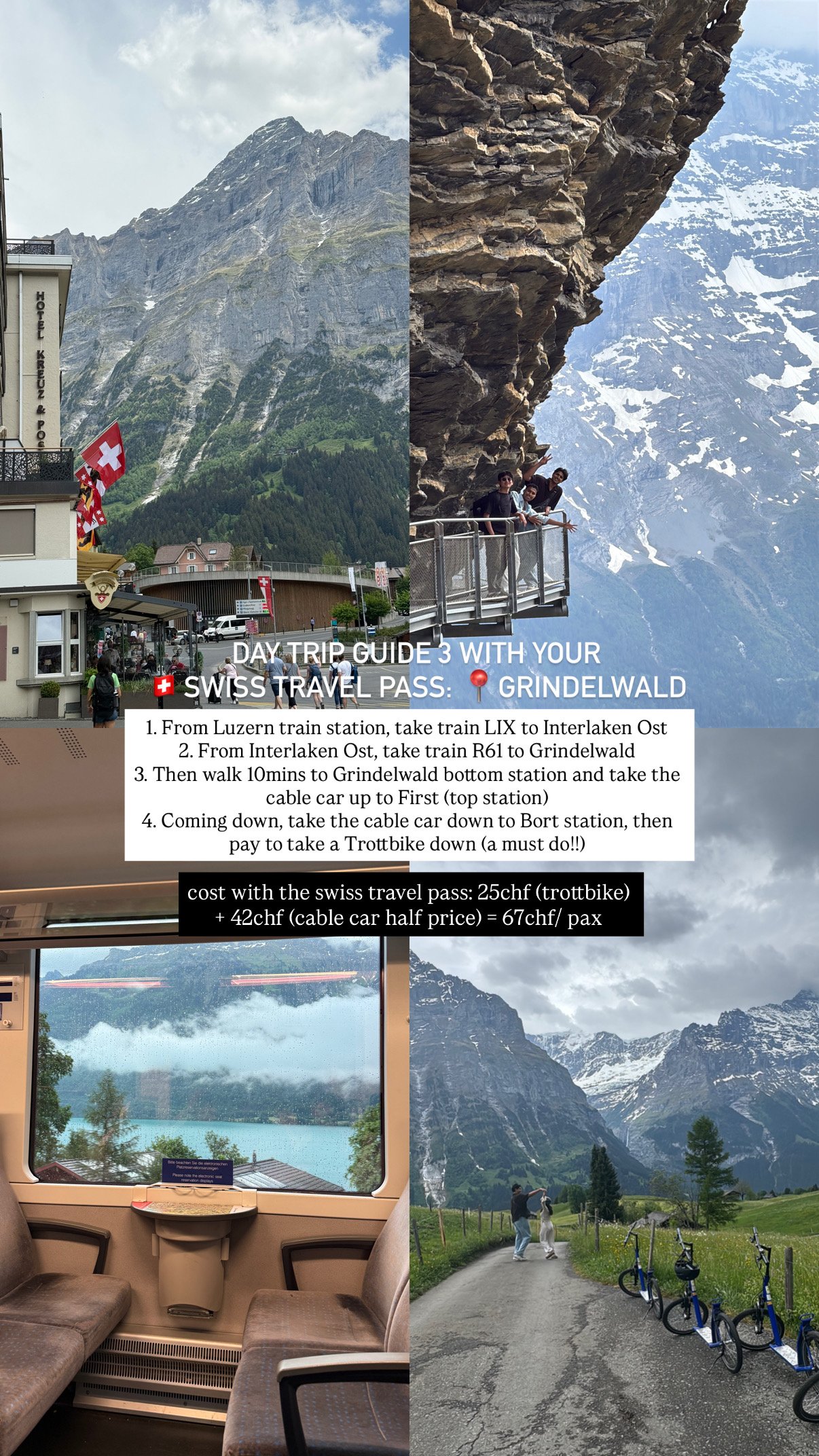
Best for: adventure seekers, hikers, cliff-walk lovers.
- From Luzern, take train LIX to Interlaken Ost.
- From Interlaken Ost, take train R61 to Grindelwald.
- Walk 10 minutes to the Grindelwald bottom cable-car station and ride up to First (top station).
- On the way down, take the cable car to Bort, then pay separately for the Trottibike (scooter-bike) down to Grindelwald. Highly recommended.
This was our rainy day and it did not matter one bit. The First Cliff Walk is a steel walkway bolted into the rockface high above the valley, and the Trottibike descent, flying down a mountain road in the rain with the brakes squealing, was the memory I came home with. You can book the First cable car here, but grab the Trottibike on the day at Bort.
Day 5: Mount Pilatus
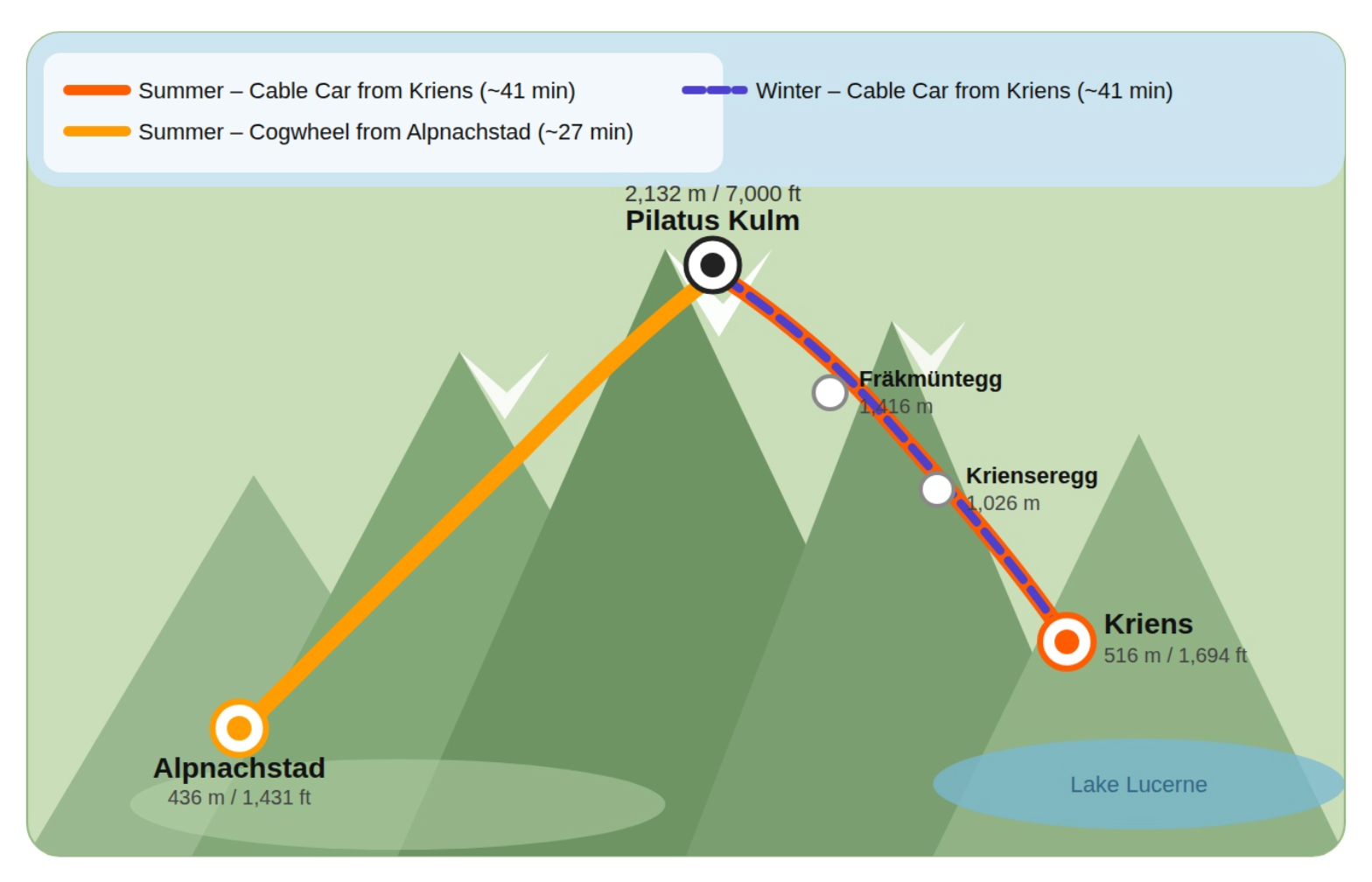
Best for: the most dramatic cable-car ride in Switzerland, great for beginners and families.
- From Luzern, take bus 1 to Kriens, Zentrum Pilatus (a short walk from our place).
- Take the Kriens cable car 2516 up to Fräkmüntegg, then switch to cable car 2517 to Pilatus Kulm.
- Come back down via the world's steepest cogwheel railway (train 83) to Alpnachstad.
- Return to Luzern by ferry 3601 across the lake from Alpnachstad.
Pilatus rises right above Kriens, so this was our easiest start. Doing it as a loop, cable car up, cogwheel train down, boat back, makes for a fantastic half-day, and it's less crowded than Rigi in my experience.
Day 6: Zermatt & the Matterhorn
Best for: bucket-list views and the most iconic mountain in Switzerland.
- From Luzern, take the train to Visp (one change along the way).
- From Visp, take train R41 up the valley to Zermatt.
- Explore Zermatt on foot, cars are banned, it's electric vehicles only.
- For Matterhorn views, take the Gornergrat cogwheel railway up.
A big day, but the trains make it painless. Zermatt is a car-free village at the foot of the Matterhorn, and the Gornergrat train climbs to 3,089 m for the classic panorama straight at that impossible pointed peak. It's a long day out from Luzern (about 3 hours each way), so start early.
Day 7: A beach day in Luzern
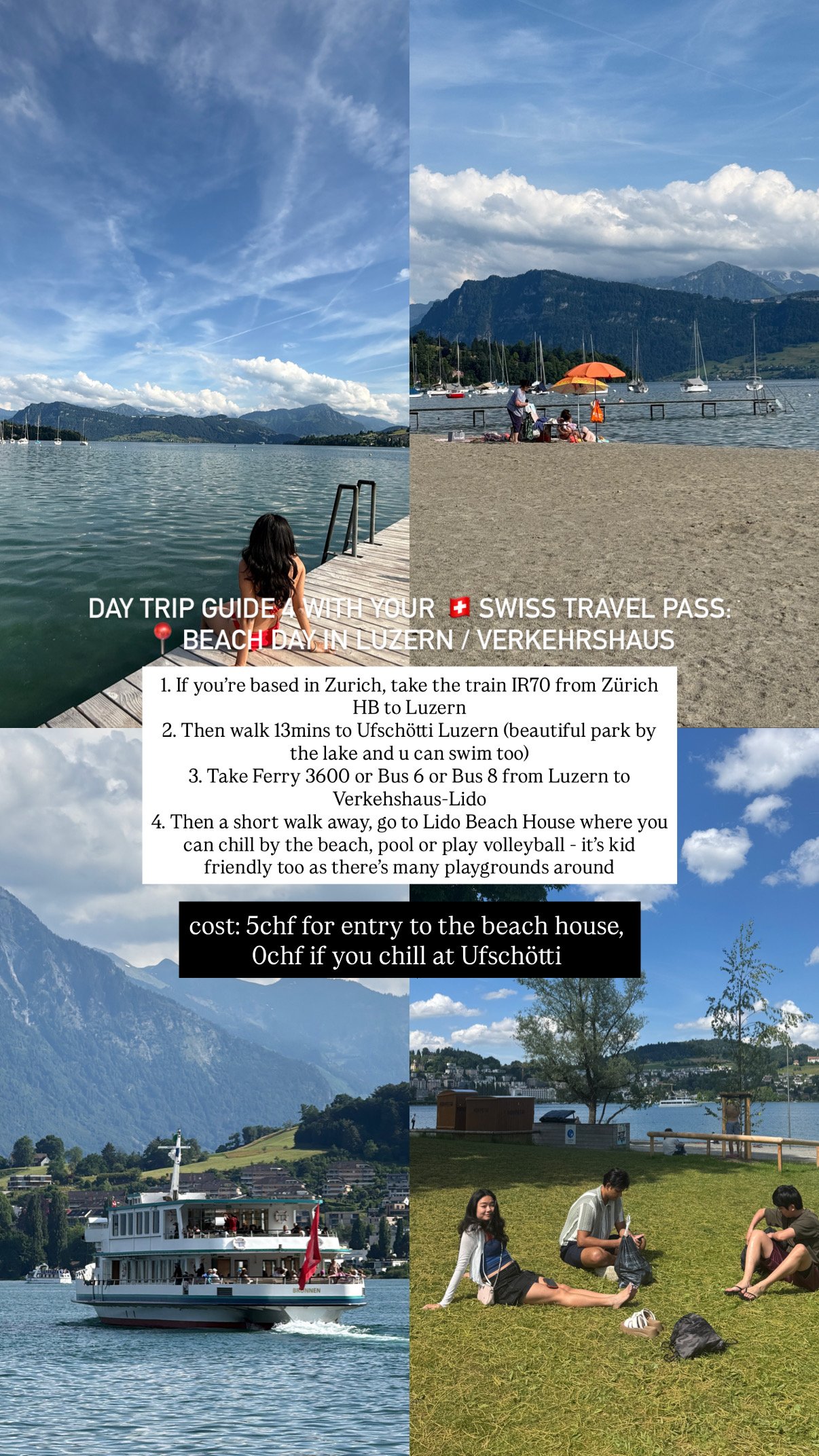
Best for: a relaxed day, families, sunshine.
- Walk or bus to Ufschötti Luzern, a gorgeous free lakeside park where you can swim.
- From Luzern, take ferry 3600 or bus 6 or 8 to Verkehrshaus-Lido.
- Head to the Lido Beach House: pool, beach, volleyball courts and playgrounds for kids.
- Round it off with the old town's painted houses, the Musegg wall and the Lion Monument.
After a run of mountains you need a day like this, or you burn out. Switzerland isn't all peaks, the lakes are swimmable in summer and so beautiful. We cooked at home, did laundry and planned the last leg.
Day 8: Chill, back to Zurich, and fly off
Best for: an easy last morning before the airport.
Nothing ambitious on the final day. We used the pass one last time to get up to Zurich, wandered the old town and the lakefront for a slow morning, then rode straight through to the airport. The pass covered us right to the gate, a small thing that felt very satisfying on the way home.
Is the Swiss Travel Pass worth it?
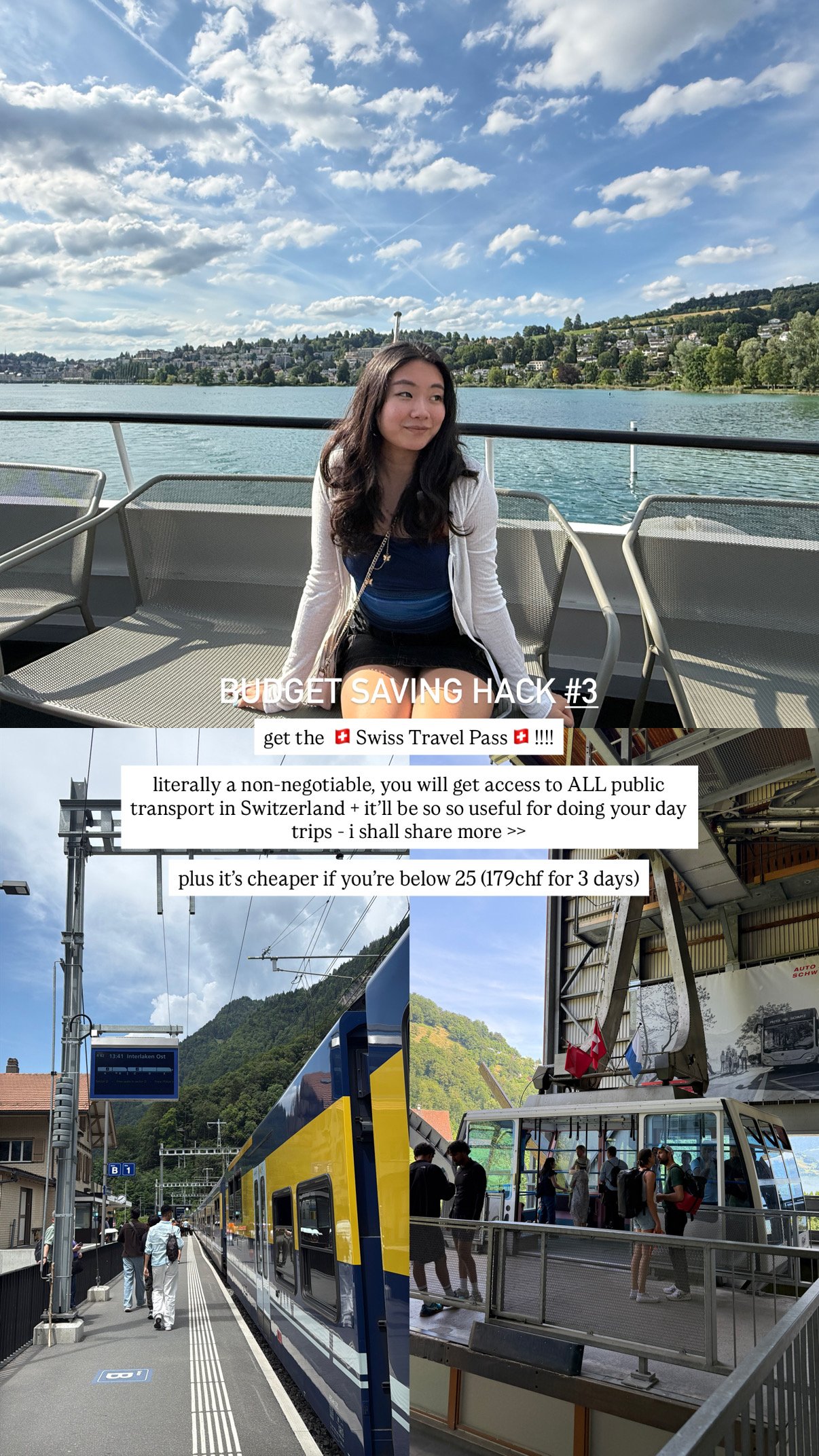
Short answer: for a trip like this one, where you move almost every day and lean on the mountains, yes, clearly. Here is the actual reasoning rather than me just saying so.
The 8-day consecutive pass cost CHF 439. Consecutive means the clock runs for 8 straight days from first use, so it only makes sense if you are actually traveling most of them, which we were. What it covered for us:
Every train and every lake boat we took, with no faffing about buying tickets each morning. The buses and trams too, including getting from Luzern out to our place in Kriens. Mount Rigi completely, cogwheel train and boat included, which is genuinely one of the best days of the whole trip and cost us nothing extra. Free entry to a long list of museums, which we dipped into on a rainy afternoon. And 50 percent off most of the big cable cars, including Grindelwald First and Pilatus.
Now the math. I added up roughly what the individual tickets would have cost if we had paid as we went: the Rigi boat and cogwheel alone is around CHF 78 round trip, a Zermatt day by train is well over CHF 100 return, and the Luzern to Interlaken and Grindelwald runs stack up fast on top of the local buses and the Zurich leg. It came to comfortably more than CHF 600 per person before you even count the 50 percent mountain discounts and the free museums. So the CHF 439 pass paid for itself and then kept giving.
The honest caveat: it is only worth it if you move. If you were planning to base yourself in one town for a week and barely leave, buy point-to-point tickets and skip the pass. But for a multi-region trip like this, it is the first thing I would book. You can check current prices and buy the Swiss Travel Pass here.
How good is public transport in Switzerland, really?
I want to spend a moment on this because it genuinely changes how you travel here. Swiss public transport is the best I have used anywhere. Trains leave on the minute, not the rough minute, the actual minute. Connections are timed so a two-minute change across the platform just works. Boats, buses, cogwheel trains and cable cars all run on the same clockwork, and the pass ties the whole thing together so you stop thinking about transport as a cost or a hassle and just hop on.
Practically, that means you do not need to base yourself in the middle of everything. We stayed outside Luzern and reached Rigi, the Bernese Oberland, Pilatus, Zermatt and Zurich all as day trips, because the network makes distance almost irrelevant. Download the SBB Mobile app for live times and platform numbers and you will barely need anything else.
Where to stay in Luzern on a budget
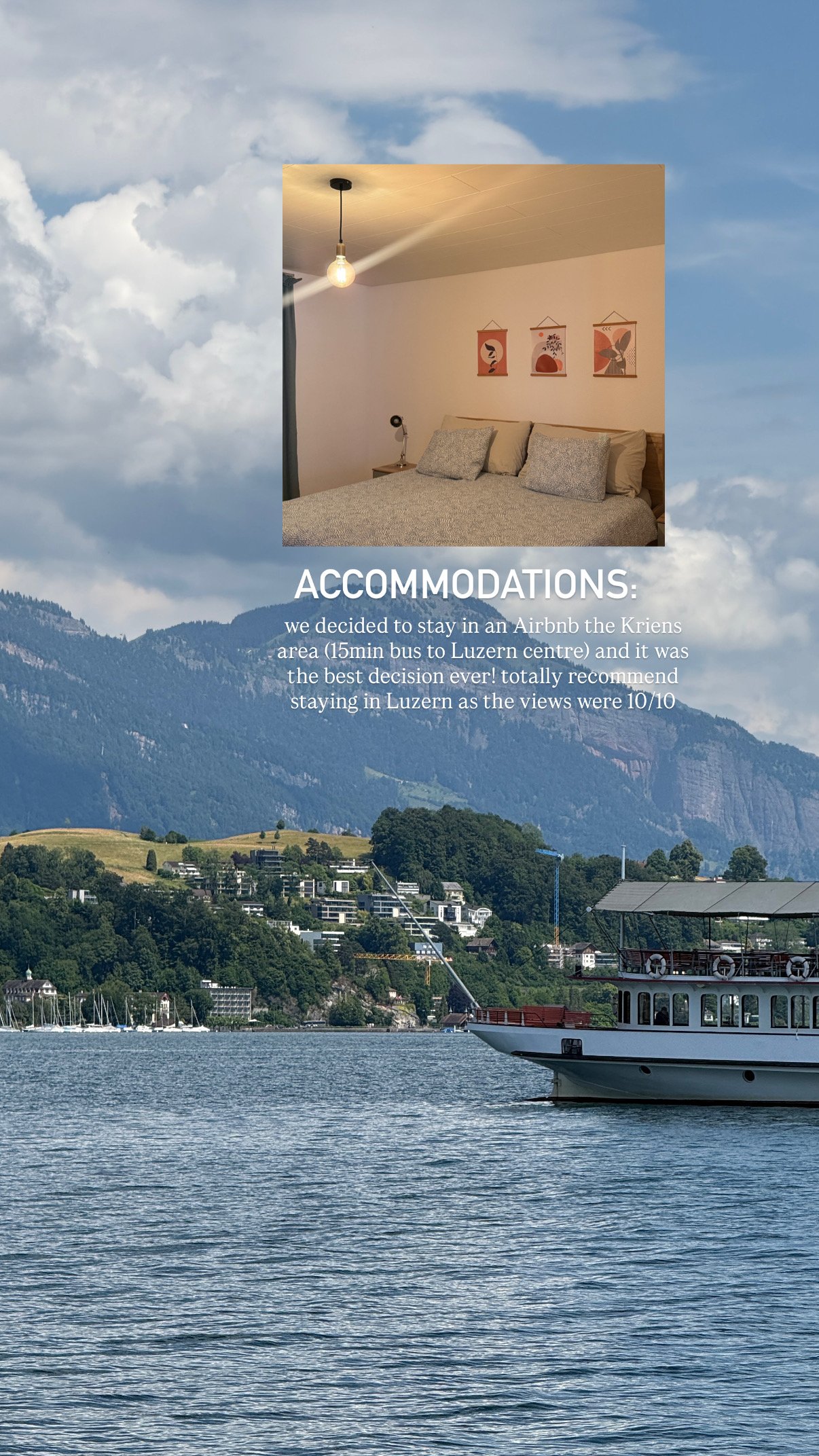
We based the whole trip in Kriens, the next town over from Luzern, rather than paying old-town prices. It was about ten minutes in on the bus, which the pass covered, and noticeably cheaper for a whole house than anything central. Kriens has a Coop, a Migros and a couple of bakeries within reach, and the bottom station of the Pilatus cable car is right there, so one of our mountain days started a short walk from the front door.
If you take bus 1 from Kriens, you're only about ten minutes from Luzern's main train station and the ferry terminal, so basing yourself out here costs a lot less without adding any real distance to your days.
How we kept food costs down: Coop, Migros and one meal out
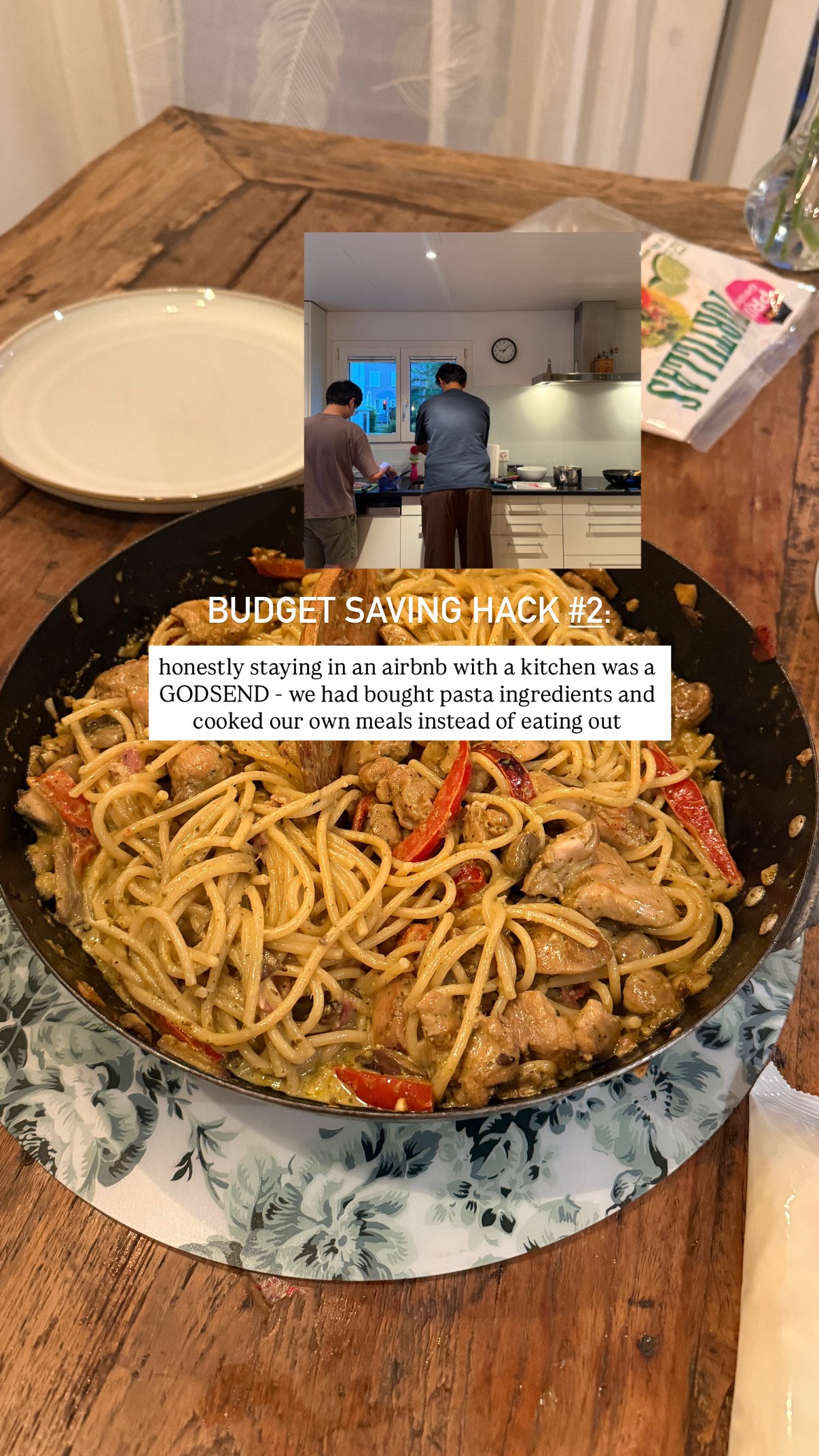
This is the unglamorous part that saved us the most money. We cooked. Most nights, in the Airbnb, with groceries from Coop and Migros, the two supermarket chains you will find in nearly every Swiss town.
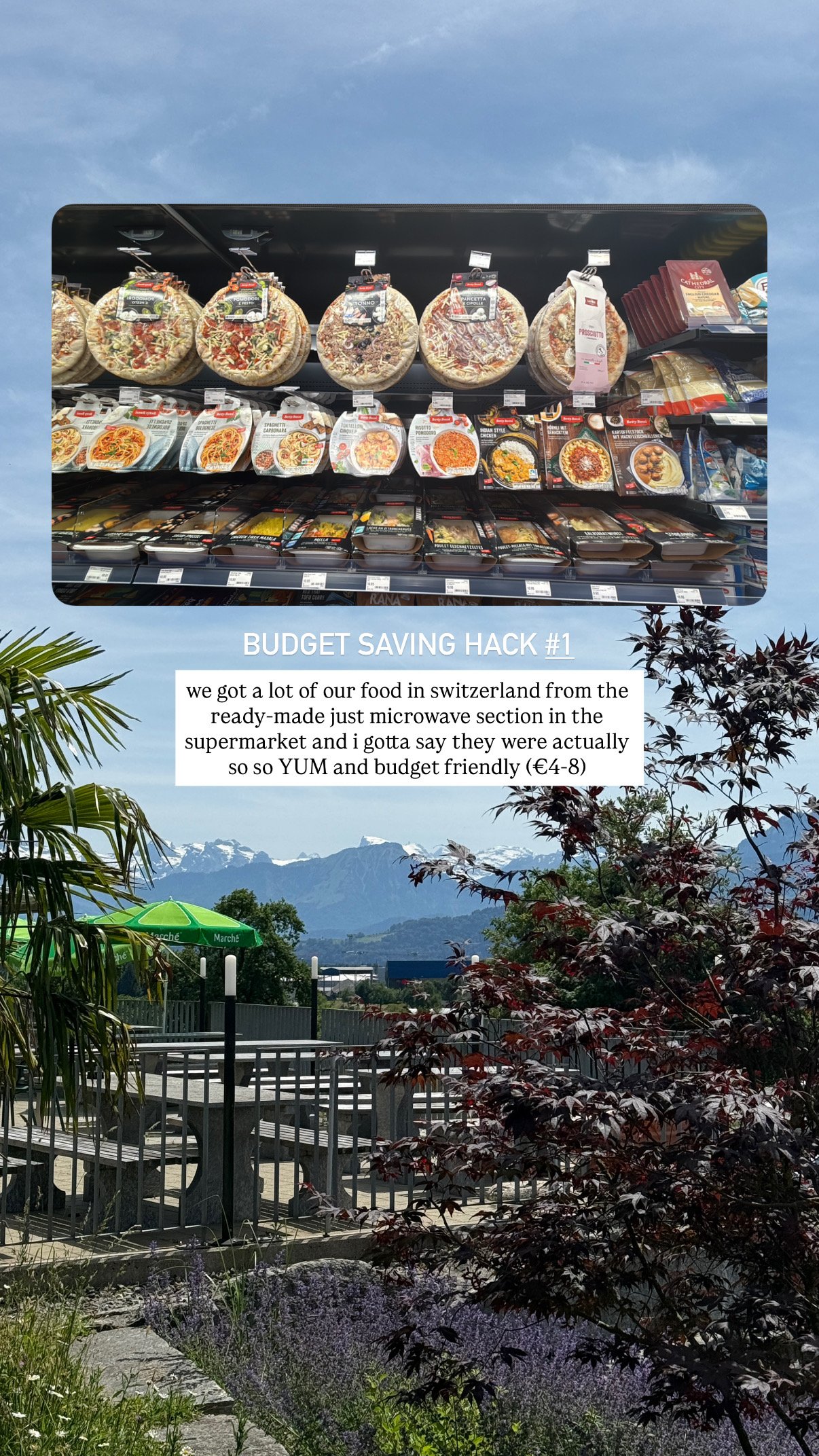
Eating out is where Swiss budgets quietly die. A normal sit-down main runs CHF 25 to 35, so we did a big shop at the start and cooked around fourteen meals between us over the trip, keeping our grocery spend to something like CHF 70 each. Both chains do cheaper own-brand ranges, M-Budget at Migros and Prix Garantie at Coop, and both are perfectly good. Two things worth knowing: the supermarkets close on Sundays, so stock up on Saturday or you will be caught out, and the smaller branches inside train stations are your friend for a quick picnic lunch before a hike.
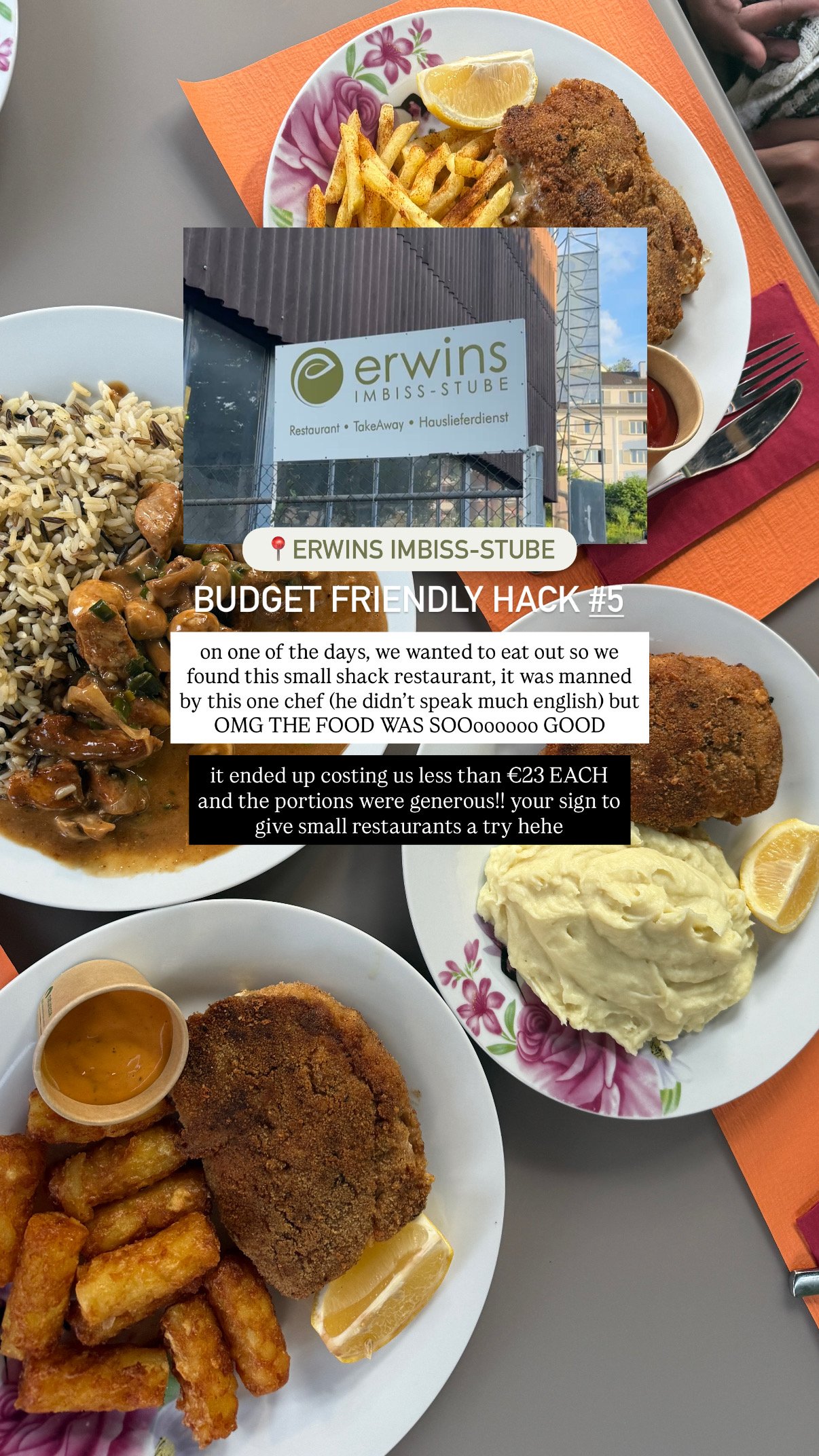
We did allow ourselves one proper meal out, at Erwins Imbiss-Stube in Luzern, which came to about CHF 25 a head and was so good I stopped feeling guilty about it halfway through the first bite. If you cook all week, give yourself at least one of these. You are in Switzerland, after all.
Do you need an eSIM in Switzerland, and the EU roaming trap
Please read this bit before you fly, because it catches people out constantly. Switzerland is not in the European Union. It sits right in the middle of Europe, it feels European in every other way, but for your phone it is a separate country. If you are relying on an EU roaming plan, or a data eSIM that only covers the EU, it very often will not work in Switzerland or will bill you extra the moment you cross the border.
The fix is easy and cheap. I bought a Europe eSIM on KLOOK that specifically includes Switzerland, which EU-only plans tend to leave out, activated it when we landed, and had data before we had even left the airport. That is the key detail: buy a plan that lists Switzerland by name, not one that just says "Europe" and assumes you will read the small print. No queuing for a physical SIM, no roaming shock on the way home.
Is the tap water really free everywhere in Switzerland?
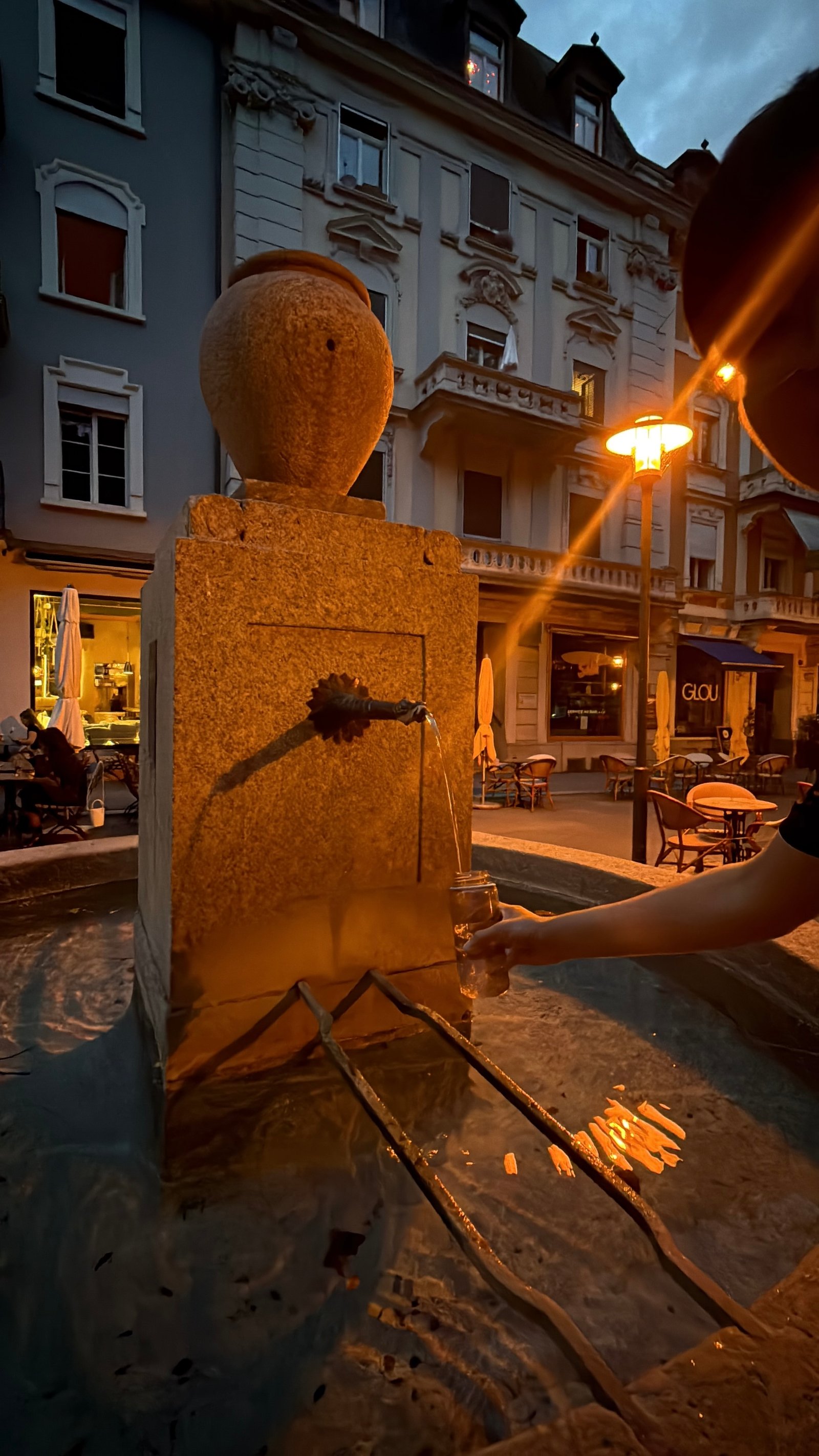
Yes, and it is a small thing that adds up over a week. Swiss towns are full of public fountains, and the water in the vast majority of them is clean, cold and drinkable unless a sign specifically tells you otherwise. We refilled our bottles constantly, in Luzern's old town, at train stations, on the mountains. Bottled water at Swiss kiosk prices would have been money poured away, especially hiking in the late spring sun. Pack a reusable bottle and you will use it every single day.
What I would tell a friend before they go
Book the pass if you are moving around, and check whether each mountain is fully covered or only discounted before you get your hopes up. Base yourself somewhere with a kitchen and split it if you can. Shop on Saturday. Carry a water bottle. Buy a Switzerland-specific eSIM, not an EU one. And leave one day completely open, because the trains make it far too easy to fill every hour and forget to just sit by a lake.
FAQ
Is the Swiss Travel Pass worth it for 8 days?
For a trip that moves around, yes. My 8-day 2nd-class pass was CHF 439 (CHF 311 if you are 25 or under), and the trains, boats and fully covered mountains I used would have cost well over CHF 600 bought separately, before the 50 percent cable-car discounts and free museums. If you are staying in one town all week, buy single tickets instead.
How much does Switzerland cost per day on a budget?
We averaged about CHF 130 per person per day over 8 days, including the rail pass, a shared Airbnb with a kitchen and cooking most meals, but excluding flights. Traveling as a group and splitting accommodation is what kept it there.
Is Switzerland in the EU?
No. Switzerland is not in the European Union, which matters most for your phone. EU roaming plans and EU-only data eSIMs often will not work here, so buy an eSIM that specifically lists Switzerland.
Can you drink the fountain water in Switzerland?
Yes. Public fountains in towns are almost all drinkable unless a sign says otherwise, and the tap water is excellent. Bring a reusable bottle and refill it everywhere.
How do you save money on food in Switzerland?
Cook. Book a place with a kitchen, shop at Coop or Migros using their M-Budget and Prix Garantie ranges, and save eating out for one or two meals you actually want. Both chains close on Sundays, so stock up on Saturday.
What is the best thing to do in Grindelwald on a budget?
The trottibike from Bort down to Grindelwald was the highlight of our whole trip and only CHF 25. Pair it with the First cliff walk (50 percent off the cable car with the Swiss Travel Pass) for a brilliant half-day.